
OEM Jewelry Manufacturing for CAD-Ready Designers
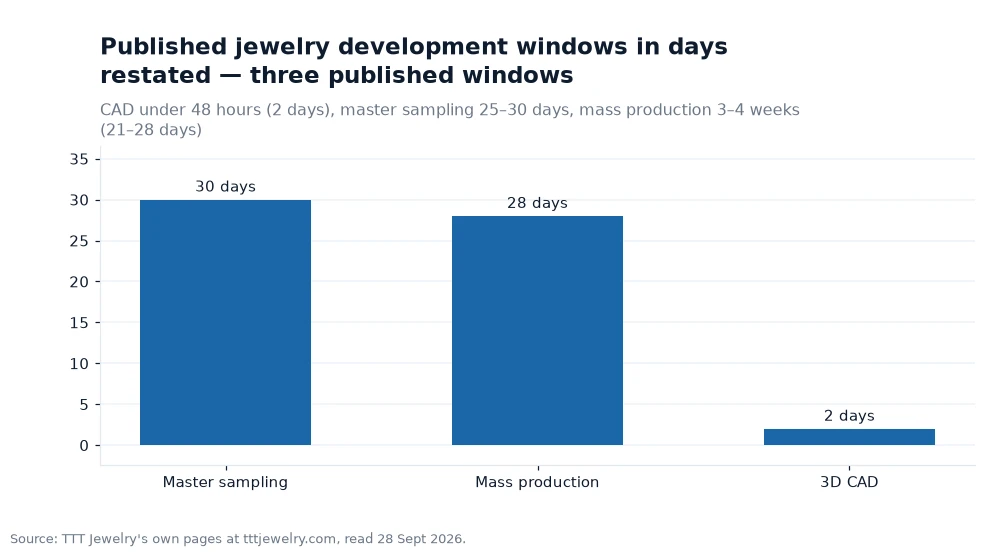
Arriving with a finished CAD file removes the concept stage of an OEM/ODM order but not the schedule. The drawing still gets reviewed in CAD within two days, a sample in 25–30 days, the full run in 3–4 weeks for the run. In days, that reads as 2, 30 and 28 — which is the whole bench calendar a designer has to plan around.

Key takeaways
- A complete CAD file shortens the conversation, not the bench: sampling is still 25–30 days.
- The drawing team reviews the file for castability, stone seating and hallmark space inside 48 hours.
- MOQ is 100 pieces in eco-brass, 50 pcs in sterling silver and 100+ pcs in stainless, counted per design, with each design counted separately.
- 14K, 18K or 24K gold, plus rhodium — and for protection, an anti-tarnish e-coat for silver and brass plus PVD for steel.
What arriving with a CAD file actually saves
It saves the development conversation. When the geometry is already decided, the consultation narrows to a feasibility answer and a cost structure rather than a design discussion, and the drawing stage becomes a review instead of a build. What it does not save is bench time, because the piece still has to be printed, cast, set, polished and plated.
Designers who expect a clean file to halve a lead time are usually disappointed at the sample stage rather than the drawing stage.
What the drawing team checks before quoting tooling
Three things are read off your file before anything is quoted. Wall thickness against the metal you named, because a section that casts in brass may not cast in silver. Stone seats against the stones specified, since a setting has to be drawn for a particular stone rather than a nearby size. And the space left for a hallmark, because the a 316L mark on steel, 18KGP on gold-plated work and S925 on silver mark plus your own logo needs a flat surface to sit on.
A file that answers all three moves into tooling quickly. A file that leaves one open gets a question back, and on a 48-hour turnaround a single question costs a day of the window.
The three development windows in days
Restating the published windows in days makes them easier to slot into a design calendar, because a designer already plans in days rather than weeks.
| Stage | Published window | In days |
|---|---|---|
| 3D CAD review and renderings | under 48 hours | 2 |
| Master physical sample | 25–30 days | 25–30 |
| Mass production | 3–4 weeks | 21–28 |
Read the middle row carefully. The sample is not a preview of production, it is the first run of one, which is why a design change requested after it costs tooling rather than a redraw.
Worked example: 2 + 30 + 28 days
Take the outer edge of each window. CAD at 48 hours is 48 ÷ 24 = 2 days. Sampling at its published maximum is 30 days. Production at 4 weeks is 4 × 7 = 28 days. The sum is 2 + 30 + 28 = 60 days.
At the inner edge it is 2 + 25 + 21 = 48 days, so a custom run occupies 48 to 60 days of bench time before shipping. If the sample sits unapproved for a week, that week goes straight onto the total. The additions are mine; the published windows they use are 48 hours, 25–30 days and 3–4 weeks.
Minimums when the file is already clean
A clean file does not lower the minimum, because the minimum is set by tooling and finishing rather than by how ready the drawing is. Silver starts at 50 pieces per design, artisan eco-brass at 100 and stainless steel at 100+. For a designer with a wide range and a small budget, that ladder is the strongest argument for sampling the first season in silver.
Stainless steel deserves a second look if the pieces have to survive water and daily wear, because the PVD vacuum plating used on that route is applied for exactly that reason — at 100+ pieces per design.
Where designers get surprised: plating and hallmarks
Two details cause more re-samples than geometry. The first is plating: 14K, 18K and 24K gold and rhodium all read differently over the same surface, and a brushed area under plating looks nothing like a polished one. The second is the hallmark, which is laser engraved with your logo and is therefore part of the artwork rather than a stamp added at the end.
Design both into the file. A hallmark that has to be squeezed onto a curved surface later will move the drawing back to the beginning of the 48 hours.
Reorders and version control on your own files
The strongest reason to keep the drawing is that it makes every later run comparable. Reorders skip sampling entirely once the mould and finish exist, so the approved drawing becomes the reference document rather than a project deliverable. Name your versions the way the workshop names them, and nobody has to guess which file went into which batch.
Ask for the drawing back in the same format you sent it in. It is your file, and having it in hand makes a future tooling move a re-quote rather than a redevelopment.
Where a clean file most often needs one fix
The recurring answer is the hallmark. A drawing can be dimensionally perfect and still leave no flat surface for an S925, 316L or 18KGP mark alongside a brand logo, which means the file comes back for one edit before tooling. The second most common fix is a bail or finding: the geometry is right, but the attachment point assumes a chain that a different supplier would attach differently.
Both are minute changes in a CAD file and expensive changes after casting. If a designer spends one hour on those two details before submitting, the review turns into an approval instead of a round trip, and the 48 hours stays at 48 hours. Tooling and material behaviour for a designer who arrives CAD-ready sits with the jewelry OEM ODM partner, and the stainless steel pages The wholesale programme page carries the rest. cover the two alloys most of that work lands on.
Frequently asked questions
Does a finished CAD file skip the drawing stage?
It skips the build, not the review. The file is checked for castability, stone seating and hallmark space, and renderings come back inside 48 hours for sign-off.
Can I supply my own mould instead of having tooling cut?
Discuss it during consultation. Tooling is usually cut per account, and a supplier acting as an OEM/ODM partner will confirm whether an existing tool suits its casting route.
How many pieces do I need for a first run?
Floors are 100+ in stainless work, 100 in artisan eco-brass and 50 pcs in the silver line, by design, and they hold design by design.
Turning a design calendar into an order calendar
Designers plan backwards from a launch and forwards from a sketch. A supplier timeline works the other way, so the useful exercise is to fix the two approval dates — drawing and sample — and let everything else settle around them. Those are the only two points where a designer's week directly changes a shipment date.
Everything after them is machine time. If the range includes a plated fashion line, the stainless steel programs cover the PVD route, while the custom brass jewelry pages set out the eco-brass minimum and finishing sequence.
Nothing here is invented — the confidentiality terms along with the approved-sample benchmark, followed by the laser engraving option — all of it comes from the company's own pages on tttjewelry.com, from my own reading on 28 Sept 2026. ISO 9001:2015 appears on the same site as the quality-system claim. The side-by-side reading is mine alone [1]