
Deciding Whether to Visit a Scent Museum: A Buyer's Framework
A scent museum is a strange object in a sourcing process. It is impressive, it is memorable, and it is easy to let it stand in for evidence it cannot provide. The honest position is that a visit is genuinely useful for a narrow set of questions about taste, material access and category ambition, and useless for the questions that decide whether a supplier can fill an order correctly. A buyer who separates the two in advance gets a better day out and a better shortlist.
Key takeaways
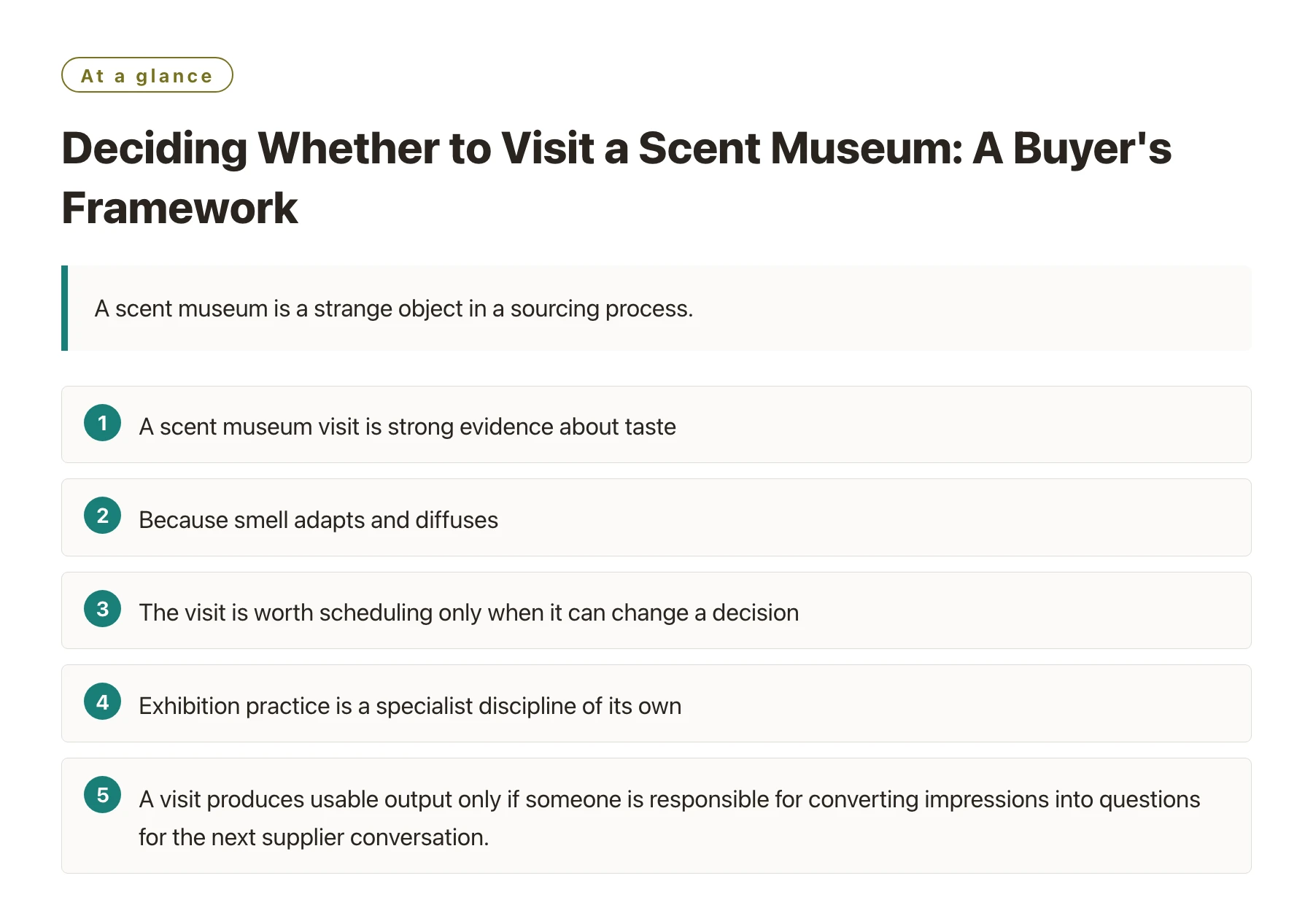
- A scent museum visit is strong evidence about taste, material access and category commitment, and weak evidence about production quality, capacity or service.
- Because smell adapts and diffuses, what a visitor remembers is not what was shown, which makes note-taking at the station more reliable than a verdict at the exit [1].
- The visit is worth scheduling only when it can change a decision, so the decision it is meant to inform should be named before the booking is made.
- Exhibition practice is a specialist discipline of its own, and a museum can be excellent while the factory behind it is merely competent, or the reverse [2].
- A visit produces usable output only if someone is responsible for converting impressions into questions for the next supplier conversation.
- For a scent brand, the most transferable lesson from a museum is about sequencing and framing, not about formula or price.
Sourcing decisions are usually made on documents and samples rather than on visits, and there is a reason for that. A visit is expensive in time, generous to the host, and difficult to compare across candidates because no two visits are the same. It produces impressions rather than records, and impressions are exactly what a procurement process is designed to discount.
That does not make a visit worthless. It makes it a specific instrument. Used well, it compresses weeks of indirect research about a supplier's taste and material reach into an afternoon. Used badly, it becomes the reason a shortlist was decided before the paperwork was read.
The framework below is about deciding in advance which of those two outcomes a visit is going to produce, and what to do with the material it generates afterwards.
Five questions to settle before booking
- Which decision is this visit supposed to inform?Shortlist, brief, negotiation or nothing at all. If no decision changes either way, the visit is entertainment, and there is nothing wrong with that as long as it is not billed as due diligence.
- What would change your mind?Name the two or three observations that would move a supplier up or down. A visit with no falsifiable expectations will confirm whatever impression the host intends.
- Who should come, and who should stay away?Three or four people can smell and note independently. A group of ten cannot, and the loudest opinion in a large group tends to become the group's finding.
- What will you ask that has a verifiable answer?Material sourcing, category history, how the house describes its own style, and which product families it works in. Those are useful and hard to fake. Capacity and quality claims are better answered with documents.
- How will the notes be used within a week?A visit that does not produce a written question for the next supplier conversation or the next brief has not paid for the travel.
What a visit adds, and what it cannot replace
| Sourcing question | What a visit genuinely adds | What it cannot replace |
|---|---|---|
| Does this house have taste? | A point of view about materials and restraint that is visible in what it chooses to show | A brief review, which is where taste is actually tested against a commercial need |
| Does it have material reach? | Indications of which families and qualities the house works with repeatedly | A specification and a price for a named material |
| Is it committed to the category? | Evidence of long-term investment that has no direct revenue attached | Capacity, lead time and service commitments, which belong in a contract |
| Can it fill my order correctly? | Very little, beyond the impression the host chooses to create | Factory audits, fill records, test reports and batch documentation |
| Would a long-term partnership work? | A sense of how the team talks about its own work and about customers | Reference conversations and a project run under real deadlines |
The pattern is consistent: visits are strong on the questions that involve judgement and weak on the questions that involve proof.
Why the evidence is weaker than it feels
A museum is a designed experience, and designed experiences are curated in the same sense that a product photograph is curated. What a visitor sees has been selected, sequenced and lit. That is not a criticism; it is the nature of the form, and it is worth understanding before treating a room as a data point [2]. Industry bodies in the fragrance sector run their own public-facing education programmes, which is one reason scent has become a subject people expect to encounter outside a shop [3].
There is also a perceptual problem. Smell adapts, so the first material of a visit and the eighth are not judged on equal terms, and a visitor's memory of a scent is reconstructed rather than recalled. A house can therefore present a genuinely excellent collection and still leave a visitor with a misleading impression of it, purely because of sequence.
None of this makes a perfume museum in Guangzhou perfume museum in Guangzhou a wasted afternoon. It makes it a specialist input, useful for the questions it can actually answer and misleading when asked to answer the rest.
The most useful corrective is a written record taken on the spot. Two people noting independently, without discussing, produce a far better picture of what was actually presented than any conversation afterwards.
Converting an afternoon into something usable
The output of a good visit is a set of sharper questions. For example: which material families does the house return to, and does that match the brief? How does the team describe the difference between a safe accord and an interesting one? Which parts of the process does the house put on display, and which parts does it talk around?
Those questions then have somewhere to go. A shortlist can be narrowed against them, and examples of fragrance projects examples of fragrance projects in the supplier's portfolio can be read with more specific attention to whether the range of work matches the range the brand needs.
The visit should also feed the checks that matter before signing a contract the checks that matter before signing a contract. A museum confirms nothing about documentation, allergen handling, batch traceability or change control, and those are the topics that decide whether a supply relationship survives its second year. Treat the visit as an input into that list rather than a substitute for it.
There is one more use, less obvious and more valuable. Seeing how a well-designed sequence changes what a visitor notices is directly transferable to product work: the order of samples in a discovery set, the copy on a card, the first item a subscriber opens in a monthly box. The museum is, among other things, a masterclass in how order shapes judgement, and a subscription brand makes that kind of sequencing decision every month.
A visit is worth the day if it changes one question you were planning to ask. If it only confirms what the supplier's own material already said, the useful takeaway is that the material was accurate, which is a small but real finding.
Sources
- ICOM — International Council of Museums —— The international organisation representing museums; publishes the ICOM museum definition and professional standards for museum practice.
- Museums Association —— A professional body for museums, publishing guidance and research on museum practice and visitor experience.
- The Fragrance Foundation —— A non-profit organisation for the fragrance industry, running perfumery education programmes and industry recognition.
Frequently asked questions
Should a scent museum visit be part of supplier due diligence?
It can be part of supplier assessment, but it is not due diligence. It speaks to taste, material access and category commitment. Evidence about production quality, batch control and service comes from audits, test reports and references.
When is a museum visit worth the travel time?
When it is expected to change a decision, such as building a shortlist or preparing a brief. If the shortlist is already fixed and the brief already written, a visit is unlikely to alter the outcome and is better treated as optional.
Why do visitors disagree so strongly about the same exhibits?
Because smell adapts, because it interacts with skin chemistry, and because a sequence creates contrast effects between one station and the next. Independent notes taken at each station usually reconcile the disagreement better than discussion after the fact.
What is the strongest signal a manufacturer's museum can send?
Sustained investment in a category that produces no direct revenue. That indicates a long-term view, though it says nothing about whether the factory can meet a specific order under a specific deadline.
Can a visit replace a factory tour?
No. The two answer different questions and are usually paired. A museum shows how a house thinks about scent. A factory tour shows how it controls production, and the second is the one that should carry weight in a sourcing decision.