
Hiring a Mining Company: Where the Contract Ends and the Pool Begins
A mining company sells a building, a power feed and the hands that swap a failed fan. A pool sells a settlement schedule. At 281 TH/s those two things are easy to tell apart: the pool credits 0.00012606 BTC a day, which is $10.68 at $84,692 per BTC, and $10.25 once the listed 4% on the block-reward component comes out. A host cannot change that credit. It can only decide whether the machine is still running when the credit falls due.

Key takeaways
- At 281 TH/s the pool credits 0.00012606 BTC a day: $10.68 gross, $10.25 after the listed 4%.
- At 2.81 PH/s the same arithmetic gives 0.00126058 BTC a day, $106.76 gross and $102.49 net.
- PPS+ settles hourly against current difficulty, while PPLNS pays after 6 confirmations over a 5-round window.
- Hold an all-in hosting quote against the daily credit at your own hashrate before any hardware ships.
Two vendors, two different promises
The pool's promise is arithmetic. Shares are counted, difficulty is read, and the block-reward component settles hourly under PPS+. The hosting company's promise is physical: a temperature range, a power budget, a spare-parts shelf and a response time when something breaks. Both promises matter, and neither substitutes for the other. A facility with immaculate cable management and a pool account that never sees a share is a very tidy way to earn nothing.
That is why the two purchases belong on separate sheets of paper. On the mining sheet the inputs are hashrate, network total, subsidy and payout scheme. On the hosting sheet they are price per kilowatt-hour, rack space, uptime terms and repair policy. Mixing the two produces the familiar confusion in which an operator blames the pool for a dip that came from a tripped breaker.
There is a third sheet, smaller but worth keeping: the cash-flow sheet. Coins arrive in a pool account, and the hosting invoice arrives in dollars or local currency. The gap between those two events is a working-capital problem, not a mining problem. Zero-fee mining payouts and a multi-currency wallet in the same account shorten the path from credit to invoice, and the App puts the balance on a phone without a laptop. None of that changes the daily credit, but it changes how often a good month feels like a bad one.
What the directories actually list
ViaBTC Mining Companies is the wider of the two entry points and covers firms across the mining business, from hardware sellers to operators. Miner Hosting is the narrower category for providers that run machines they do not own for a fee. Reading both is useful because the same firm often appears in each with a different offer attached.
A directory entry is a starting point, not a due-diligence report. It tells you a company exists and roughly what it does. It does not tell you the all-in rate, the notice period, or who pays for a replacement hash board in month seven. Those answers come from the contract, and they should be requested in writing before anything is shipped.
The credit line does not move with the address
At 281 TH/s the daily credit is 0.00012606 BTC. Put the same machine in a garage, a container or a hall with forty racks and the figure does not change, because the pool pays for shares at the current difficulty rather than for a postal code. Scale the hashrate and the credit scales with it: 1.124 PH/s earns four times as much, and 2.81 PH/s ten times as much.
Under PPLNS the timing changes rather than the principle. Payment arrives after 6 confirmations and is shared across the last 5 difficulty rounds, so any single day is an average rather than a promise. Either way, the number to hold against a hosting invoice is the daily credit at your hashrate, not the hashrate printed on the machine's specification sheet.
Convert the quote into the same units as the payout
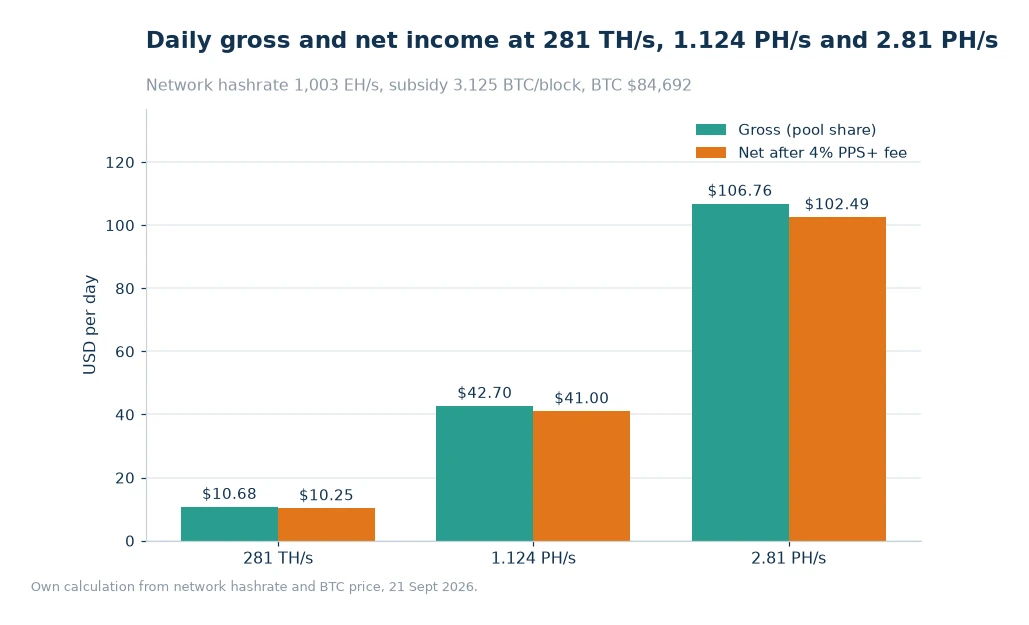
Hosting quotes arrive per machine, per kilowatt or per rack, and comparing any of them with a BTC credit is where most confusion starts. Convert everything to dollars per day at current prices, then compare. The table does that at three hashrates, with the listed 4% already applied in the final column.
| Hashrate | BTC per day | Gross USD | After listed 4% |
|---|---|---|---|
| 281 TH/s | 0.00012606 | $10.68 | $10.25 |
| 1.124 PH/s | 0.00050423 | $42.70 | $41.00 |
| 2.81 PH/s | 0.00126058 | $106.76 | $102.49 |
A modest hosting fee is a large share of $10.25 a day. At 281 TH/s a slot billed at $6 a day before power would consume more than half the credit, and that is before the electricity line. At 2.81 PH/s the same $6 is a rounding error. This is the practical reason small miners cluster in shared facilities instead of renting their own: the fixed part of the cost does not shrink with the machine.
Worked example
Start from the network, not from a screenshot of somebody else's dashboard.
- Network output: 3.125 BTC per block × 144 blocks = 450 BTC a day.
- Output per TH/s: 450 ÷ 1,003,107,267 = 0.000000448606 BTC.
- At 281 TH/s: 281 × 0.000000448606 = 0.00012606 BTC.
- In dollars: 0.00012606 × 84,692 = $10.68.
- After the listed 4% on the block-reward component: 10.68 × 0.96 = $10.25.
- At 2,810 TH/s: 2,810 × 0.000000448606 = 0.00126058 BTC, or $106.76 gross and $102.49 net.
The step from 281 TH/s to 2.81 PH/s is exactly ten times on every line, which is the useful check. A hosting quote that looks acceptable at one scale may not be at another, and the arithmetic will say so long before the invoice does.
The questions that separate a host from a reseller
Four answers decide most of the economics. What is the all-in rate per kilowatt-hour, cooling included? What uptime is promised, and what happens to the fee during an outage you did not cause? Who pays for repairs, and how long may a unit sit idle before it is replaced? What notice is needed to leave, and does the hardware leave with you? A provider that answers all four in writing can be compared with another. One that answers only the first is selling floor space.
Two smaller items are worth pinning down. The term matters: a contract longer than the useful life of the machines shifts the risk of ageing hardware onto the miner while the host keeps a fixed fee. Prepayment matters too, because a year paid up front is a loan to the provider, and the discount for it is only worth taking if it beats what the money would do elsewhere. Both are ordinary commercial questions and neither is rude to ask.
Frequently asked questions
Does a mining company affect what the pool pays me?
No. At 281 TH/s the pool credits 0.00012606 BTC a day, or $10.25 after the listed 4%, wherever the machine is installed, because settlement follows shares and difficulty rather than location.
What is the difference between Mining Companies and Miner Hosting?
Mining Companies is the wider directory of firms in the mining business, while Miner Hosting covers providers that run machines they do not own for a fee, and many firms appear in both with different offers.
How do I compare a per-machine hosting price with a BTC payout?
Convert both to dollars per day at the current BTC price: 281 TH/s yields $10.25 net and 2.81 PH/s yields $102.49 net, so a fixed daily fee weighs far more heavily on the smaller machine.
Put both numbers on one page
Write the daily credit at your hashrate on the first line and the all-in daily hosting cost on the second. If the first is larger by a margin that survives a difficulty change, the arrangement is workable. If it is not, no amount of facility quality changes the arithmetic. The Profit Calculator produces the first line in dollars at current difficulty, and the second line is a question for the provider.
The Mining Farms listing is worth reading alongside the directories, if only to see how differently operators describe the same service. Compare the wording of two offers and the real differences show up quickly: who owns the transformer, who stocks spare fans, and who is called at two in the morning.
Sources: the ViaBTC companies, farms and calculator pages for directory categories and the listed 4%[1]. Chain data read 21 Sept 2026: network hashrate 1,003 EH/s, difficulty 132.76 T, 3.125 BTC per block, 144 blocks a day, BTC $84,692. Published 22 Oct 2026; credits assume continuous uptime.